Playing, Part 1 · Chapter 3: Notation and Rhythms
Learning the Note Names in Treble and Bass Clefs
Now we'll develop some techniques to begin learning the note names across the range of the treble and bass clefs (or “grand staff”). In my classes and books, I often talk about developing “guideposts” to help you recognize the notes. Our first set of guideposts consists of all the C notes (… not $100 bills!) within a four-octave range, centered around middle C, as follows:
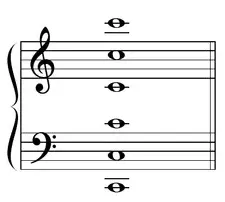
Comparing this to the previous diagram, notice that the middle C's are still there, but now we have some extra notes. We remember that the third space of the treble clef is also C (this is an octave above middle C), and that the second space of the bass clef is again C (this is an octave below middle C). The notes at the very top and bottom are also C's, and require two ledger lines each, as they are above and below the staffs, respectively.
Find and play all of these C's on your piano. (Don't forget that the note C is to the left of the set of two black keys). Play middle C with your right hand (it doesn't matter with which finger, for now!), then play the C an octave above that, then the C an octave above again. Next, play middle C with your left hand, then play the C an octave below that, then the C an octave below again. Congratulations! You just played all the notes in the above example.
Now, learning and memorizing where these C's are on the grand staff is fairly easy. Notice that there is a “mirror-image” or symmetrical relationship on either side (above and below) of middle C. These “guideposts” are handy when figuring out other notes on the grand staff—at least you could count up or down within the music alphabet, from the nearest C. The next stage is to add and memorize some more guideposts. How about adding all of the G's within this four-octave range? Let's try it:
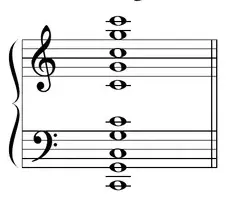
Now this stack of notes looks a bit more intense, but all we've done is add two G's in the treble clef (on the second line, and right above the top line) and two G's in the bass clef (in the top space, and on the bottom line). Although these are not exactly symmetrical on either side of middle C—well, they're pretty darn close—I think they're fairly easy to memorize visually.
Now go ahead and play all of these C's and G's on your piano. You guessed it, start with middle C in the right hand, then the G above that, then the C above that, and so on. Then play middle C with your left hand, then the G below that, then the C below that, and so on. As you're finding these notes on the keyboard, make sure you also read and relate to the written notation example.
Once you've memorized these notes, and you're trying to figure out other notes on either the treble or bass staves, remember that you'll never be more than two notes away from a C or a G, and you can work up or down the music alphabet as needed. This is, of course, only a temporary method (i.e., until you gradually learn all of the notes individually), however, it's still way better than fooling around with mnemonics for note names… at least in my humble opinion!
Let's now “fill in all the blanks” and take a look at all of the notes between the lowest and highest Cs shown in the previous examples:
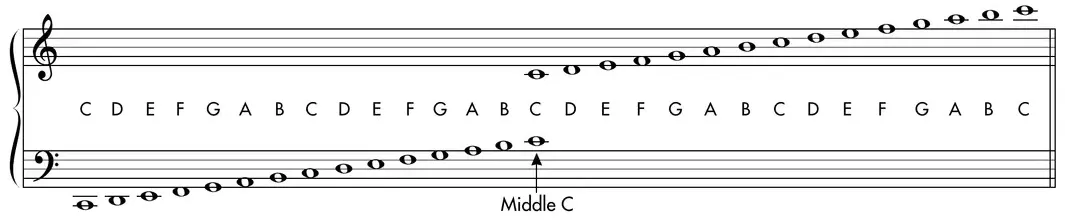
You should make it a goal to learn all of these notes individually. On the road toward this goal, learning the “guideposts” in the previous examples will definitely help you. Ninety percent (or more) of the music that you read and play will be within this 4-octave range. (However, you should still dust those keys at the top and bottom of your piano!)