Playing, Part 1 · Chapter 3: Notation and Rhythms
The Musical Staff
Now we'll begin to unlock the mysteries of music notation. The good news is that this is actually easier than you think. Once you learn and understand the rules, it all starts to make sense. Music notation will tell you which notes to play, how long the notes are played, and when to play them (among other things). If you know all this stuff already, skip on to Chapter 4 where you can start playing some tunes! But for those of you who are new to the material, or just need a refresher… here we go!
We'll start out with the musical staff, which is a collection of five parallel lines, like this:
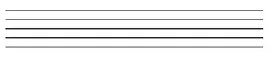
When notes are written on the staff, they can be written on the lines (the “line notes”) or on the spaces between the lines (“space notes”). You remember back in Chapter 1, we defined the music alphabet (using the letters A–G) to label the notes on the keyboard. So now we need some way to relate these letter names to the lines and spaces on the music staff, so that we know which note corresponds to each line or space. This is achieved by using a clef, which is a symbol placed at the beginning of the music staff to let us know how the letters in the music alphabet are allocated to the staff lines and spaces. Pretty cool huh!