Playing, Part 1 · Chapter 10: Intervals and Chords
Introduction to Intervals
Now it’s time for a little more music theory. But don’t worry, I’ll try to make it as painless as possible! Besides, you’re going to need this stuff to build intervals and chords, two very important components of all those cool songs that you’ll soon be playing.
An interval in music is the distance between two notes. We already got to know some intervals in the earlier chapters, such as the half step and whole step. Now we’re going to derive some larger intervals, based on the distance between the notes on the staff. Let’s look at the following interval:
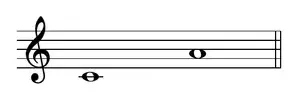
The first thing we need to determine is the interval number . To do this, we count up from the bottom note (starting at 1), and include all the letter names in between, including the top note. So, if the bottom note (C) is “1,” then D (2), E (3), F (4), G (5), and finally, A (6), thus we have a sixth. Now be aware that there are different types (qualities) of sixths, the most common being major and minor, but we’ll learn more about interval quality later.
Use the same technique to find the interval number for any two notes. The simplest is the second , which are always adjacent letter names. Skipping one letter name is a third , etc. When going from one letter to the same letter up or down, it is 8 or the octave . Some intervals that go beyond the octave such as 9ths, 10ths, and 11ths are named as such. When we get to an interval such as a twelfth, we can label this as a fifth plus an octave, etc.
