Playing, Part 1 · Chapter 10: Intervals and Chords
Creating Intervals from the Major Scale
You remember the C major scale that we built in Chapter 7? Now we’ll look at all of the intervals created between the starting note (C) and the other notes in this scale:
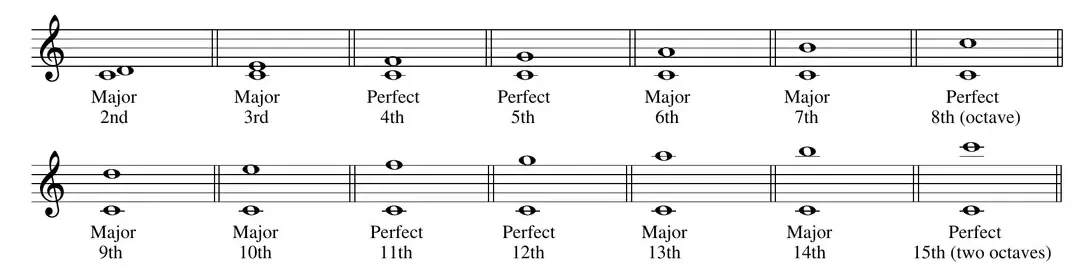
Play each of these intervals on the piano to get the different sounds “in your ear.” Since the notes are placed one above the other, or vertically, they get played at the same time try this (intervals whose pitches are played at the same time are called harmonic intervals. More about this soon!) For the second line, you’ll want to play one note in each hand.
Notice that the interval numbers are shown with an interval description, which is either major or perfect. The 4th, 5th and octave (and 11th, 12th and two octaves) are the perfect intervals, and the remaining intervals are major. Again, don’t worry too much about these interval descriptions just yet. For now, just remember that from the first note of the major (In Other Words) scale to all other notes will produce either major or perfect intervals.