Playing, Part 2 · Chapter 13: Advanced Playing – Beyond Hand Positions
Dynamics, Slurs, and Articulations
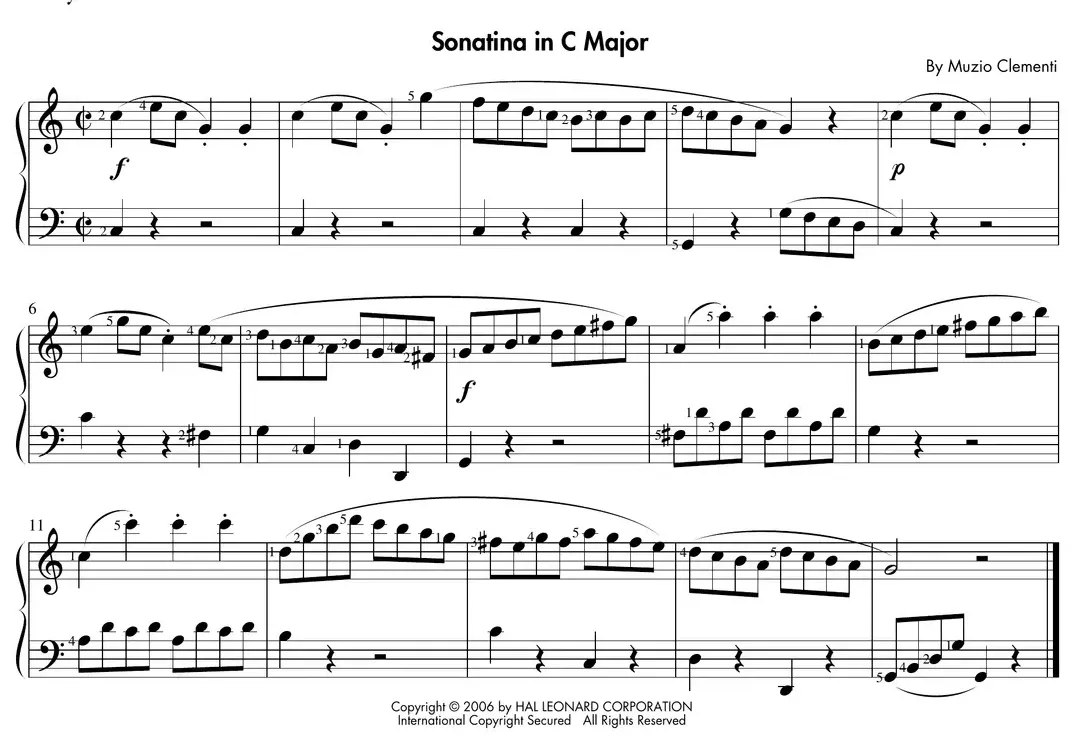
Listen to track 32 to hear an excerpt from “Sonatina in C Major” by Muzio Clementi. Notice how the notes are played: sometimes they are smooth and connected and sometimes short and separate. Also notice the changes in volume which are called dynamics. Once you’re done listening and looking at the music, we’ll discuss some of these items below, and then give the piece a try.
Loading audio…
Now let’s go over some of those things we mentioned earlier as well as some other new and important items in this piece.
- Look at the time signature. It looks like the “C” used for common time (equivalent to 4/4), except there’s now a vertical line running through it. This tells you we are in cut time, equivalent to 2/2 time (meaning two half-note beats per measure). Notice that a cut-time measure still contains the same number of quarter notes (4) that a 4/4 measure does. The difference is that we just feel two main pulses per measure (on 1 and 3), instead of four.
- Notice the f in measures 1 and 8, and the p in measure 5. These are dynamic markings, which tell you how loud or soft to play. The p stands for piano, which means soft. The f stands for forte, which means loud. Like most musical terms, these are borrowed from the Italian language.
- There are also some long curved lines above some of the notes throughout the piece. These are called slurs and mean to play smooth and connected, or legato (another one of those Italian words!).
- By contrast, some notes have dots either above or below them (for example, the G’s in measure 1, the C in measure 6, etc.). These are to be played short, so as to leave a gap between one note and the next. This is known as staccato, and is the opposite of legato (…we’ll have you fluent in Italian in no time at all!). Play staccato as if the keys are a hot stove—bounce your hand a bit for a short and detached sound.
Ok, now it’s time to get back to practicing.
As usual, work through this piece with hands separately first, using the fingerings shown. Watch out for the dynamics (loud or soft) and the articulation (legato or staccato). Start at a slow tempo, and gradually increase when you get comfortable. When you’re ready, put the hands together.
When using a metronome with this piece, start with the click on the quarter note (as usual). But then, as you get more familiar with it, try playing it with the click on the half note. This is consistent with the cut time signature we discussed earlier, in that we really have two half-note beats per measure.
Toward the end of the 18th century, the new pianoforte instrument was introduced, and it quickly began to overtake the harpsichord (the dominant keyboard instrument up to that time) in popularity. Muzio Clementi was a key figure in that transition, writing sonatas and studies that used the potential of this new instrument, and influencing the technique of many pianists. He also wrote many exercises for young pianists and students, and co-founded a music publishing and piano manufacturing company.

Finally, in this chapter, we’ll take a look at “Gymnopédie No. 1” by Erik Satie, one of the most popular and enduring pieces in the modern classical repertoire.
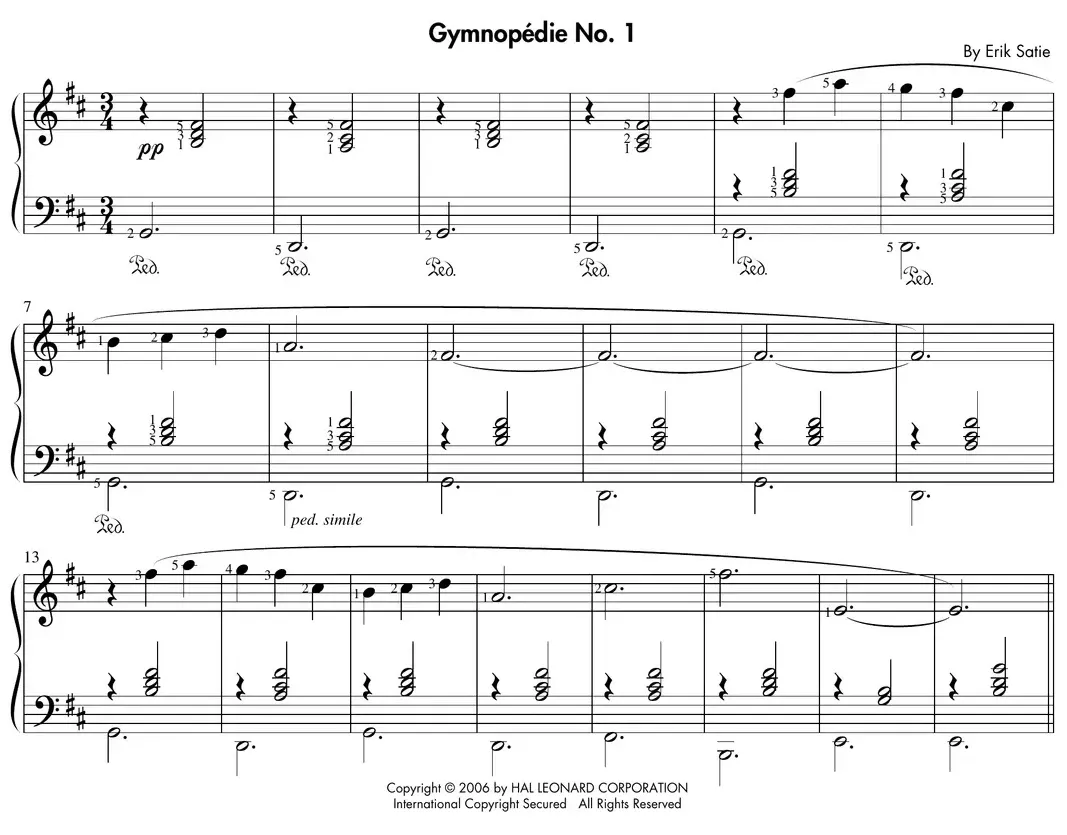
Listen to track 33, “Gymnopédie No. 1,” for a “preview” of all the interesting musical things going on in terms of dynamics (volume changes) and phrasing (how the notes and measures are grouped together by slurs, producing musical sentences).
Loading audio…
This is our first piece to mix slurs and ties together. They are visually similar, but have a completely different function. A quick review:
- Ties extend the duration of a note, and connect only two notes of the same pitch.
- Slurs tell us to play the phrase legato (smooth and connected), like in the right-hand phrase during measures 5–12. Slurs can connect many notes together (more than just two, like the tie).
You may also notice there are a lot of triads in this piece. For example, in the right hand, in measures 1 and 3, we have root position B minor triads, and, in measure 2 and 4, we have first inversion F♯ minor triads. These same triads are then played by the left hand, starting in measure 5.
Looking at the first measure, you’ll see there is a G in the bass clef, below the B minor triad in the treble clef. Remember those major 7th four-part chords we met in the last chapter? Well, it so happens that if we think of the G in the left hand combined with the triad in the right hand as all one chord, we come up with a G major 7th chord (the notes G–B–D–F♯). In playing and “figuring out” chords, it may be helpful to think of notes in the right hand and left hand separately. This type of “upper structure triad voicing” is used extensively in popular styles, as we’ll see very soon! However, the overall sound and, therefore, harmony is actually a combination of what is being played in both hands. Cool, huh?!