Playing, Part 1 · Chapter 11: Combining the Left and Right Hands
Adding Triads in the Left Hand
Next we’re going to play triads (three-note chords) in the left hand, below the melody in the right hand. So instead of just playing the root of each chord (as we did in the previous example), now we’re playing the whole chord (review major and minor triad spelling in the last chapter as needed).
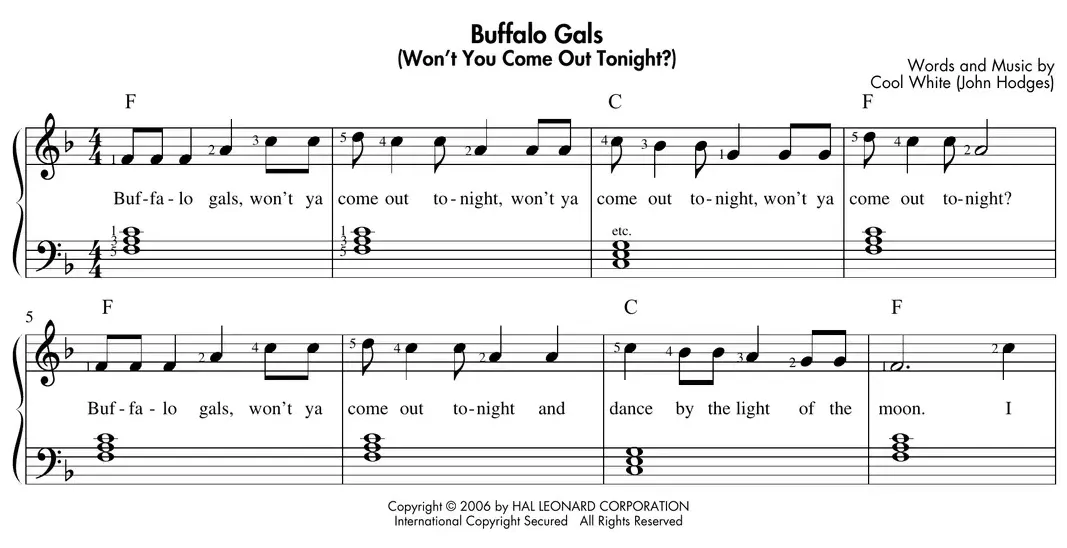
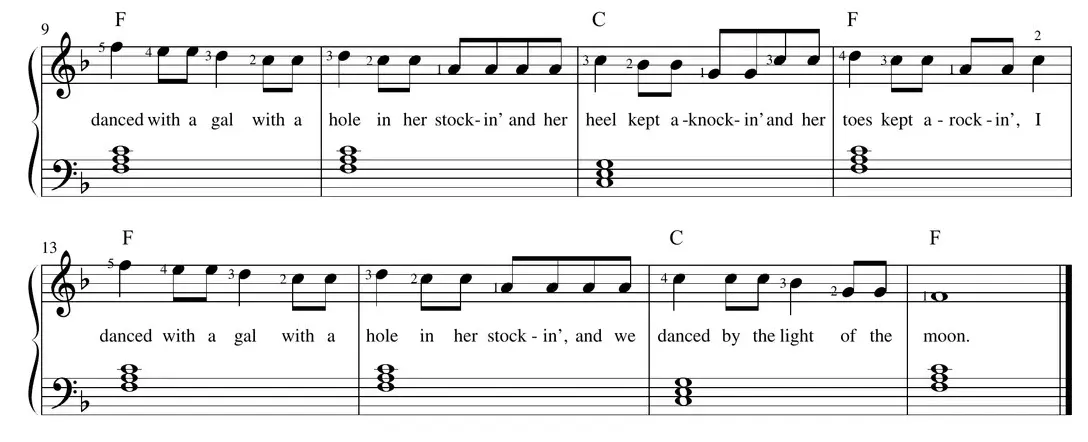
In “Buffalo Gals,” the left hand plays all of the triads with a 5-3-1 fingering. The first chord is an F major triad, and then in measure 3, the left hand must move down to place the pinkie on C to play the C major triad. In the following measure, the hand moves back up to the F chord. This back and forth movement continues throughout the song. Practice this hand move by itself a few times to get used to it. With the right hand, find the notes on the keyboard first, and then play them with the indicated fingers. Break up the song into phrases for practice as we did previously.
Loading audio…
Now listen to track 27 for some extra guidance, and then play along, hands separately first, then together.
The triads used in this song can be referred to as root position triads, as the root of each chord is on the bottom (for example, in the first F major triad in the left hand, the lowest note is F). Soon, we’ll see how to rearrange the notes of a triad using “inversions.” For now, be aware that the song is in the key of F major, and we are using two chords in the accompaniment: the F chord (I) and the C chord (V).
Next, we’ll try one more song using root-position triads in the left hand. Look at the tune and plan out where and when your left hand will need to move. The song is in the key of C major, and thus we see the common I (C), IV (F), and V (G) chords, plus a few others. What function (Roman numeral) are these “others”? There is also a “Gsus4” chord. The “sus” stands for suspended, and what is being suspended is the third of the chord. Instead of the note B, it is as if a C is hanging on from the previous C chord, delaying the complete G chord until beat 3. On the third beat, the C moves to a B as if resolving itself. The term “suspended” is usually used when the third of a chord is delayed, with a 2nd or 4th in its place. In the case of our G chord here, it is the 4th (C) that represents the suspension.
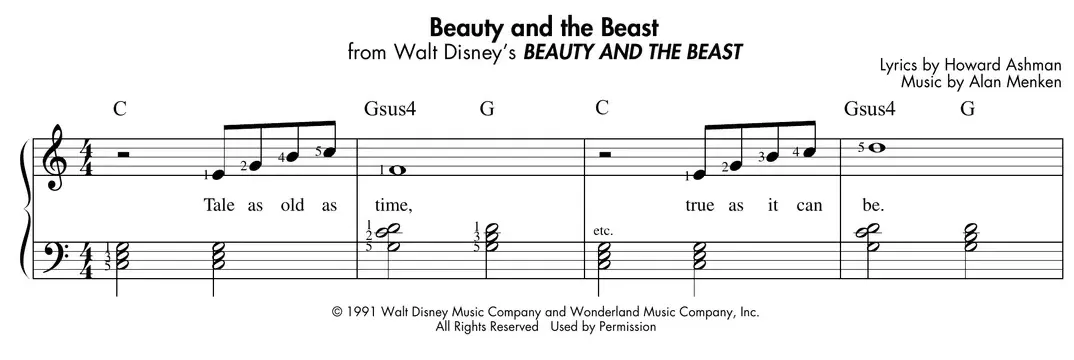
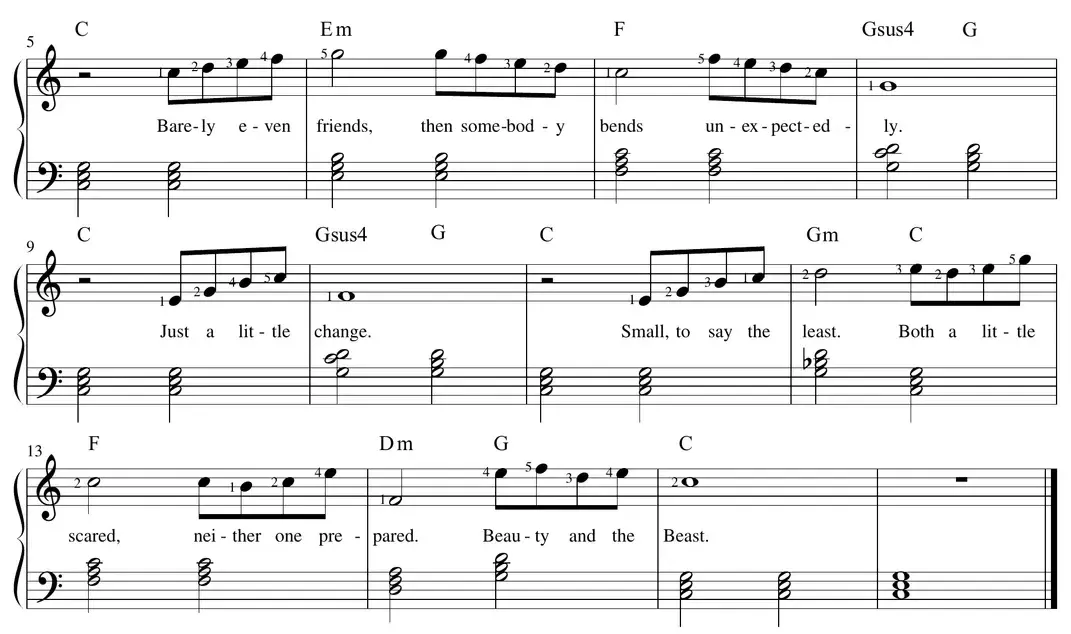
This version using left hand chords is similar to our earlier arrangement of “Buffalo Gals,” except that we now have minor and suspended chords as well as major chords.