Playing, Part 1 · Chapter 11: Combining the Left and Right Hands
Adding Single Notes in the Left Hand
Next, we’re going to work on a couple of important areas that will make your performances sound more professional. Both hands will play together, but now with more independent parts. Most often in piano music, the right hand will play the melody, while the left hand plays the accompaniment. Accompaniment parts are usually simpler than the melody, and range in a variety of styles. This part can play a simple bass line, a counter melody (another melody to help support and add interest to the main melody), chords, or a combination of all three.
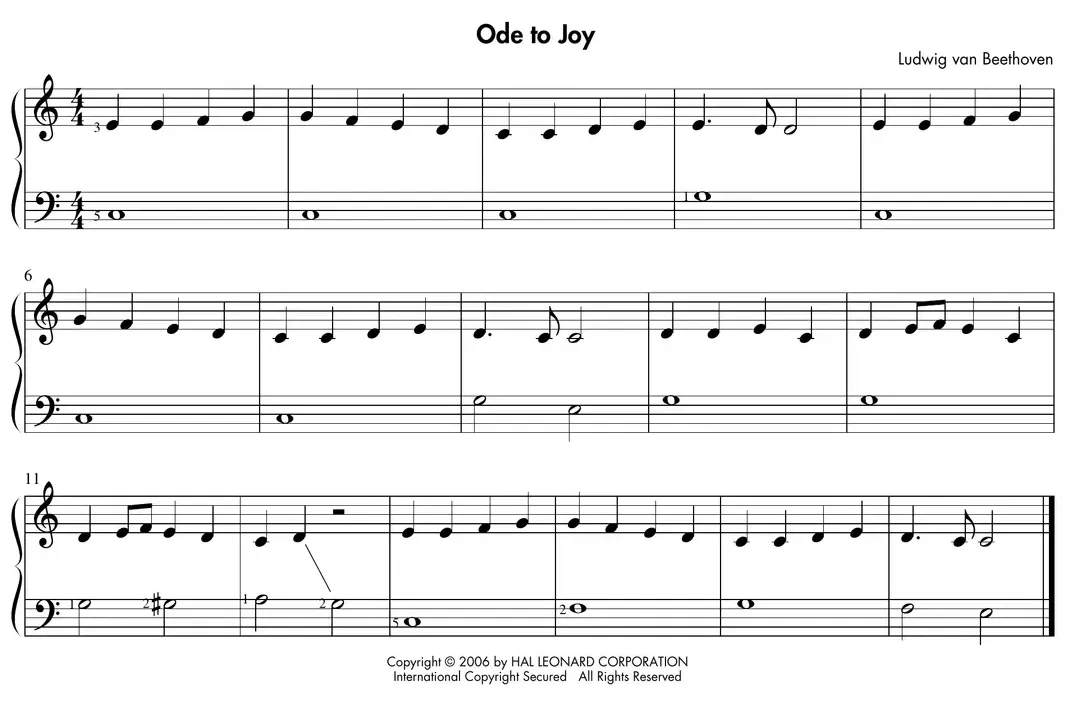
We will begin with “Ode to Joy,” a tune that includes a very simple bass line consisting of single notes. Watch out for the finger crossing in measure 11 in the left hand. Practice this part separately first, and then put the hands together.
When you feel you have this song up to tempo, give a listen to track 25 and try playing along.
Loading audio…
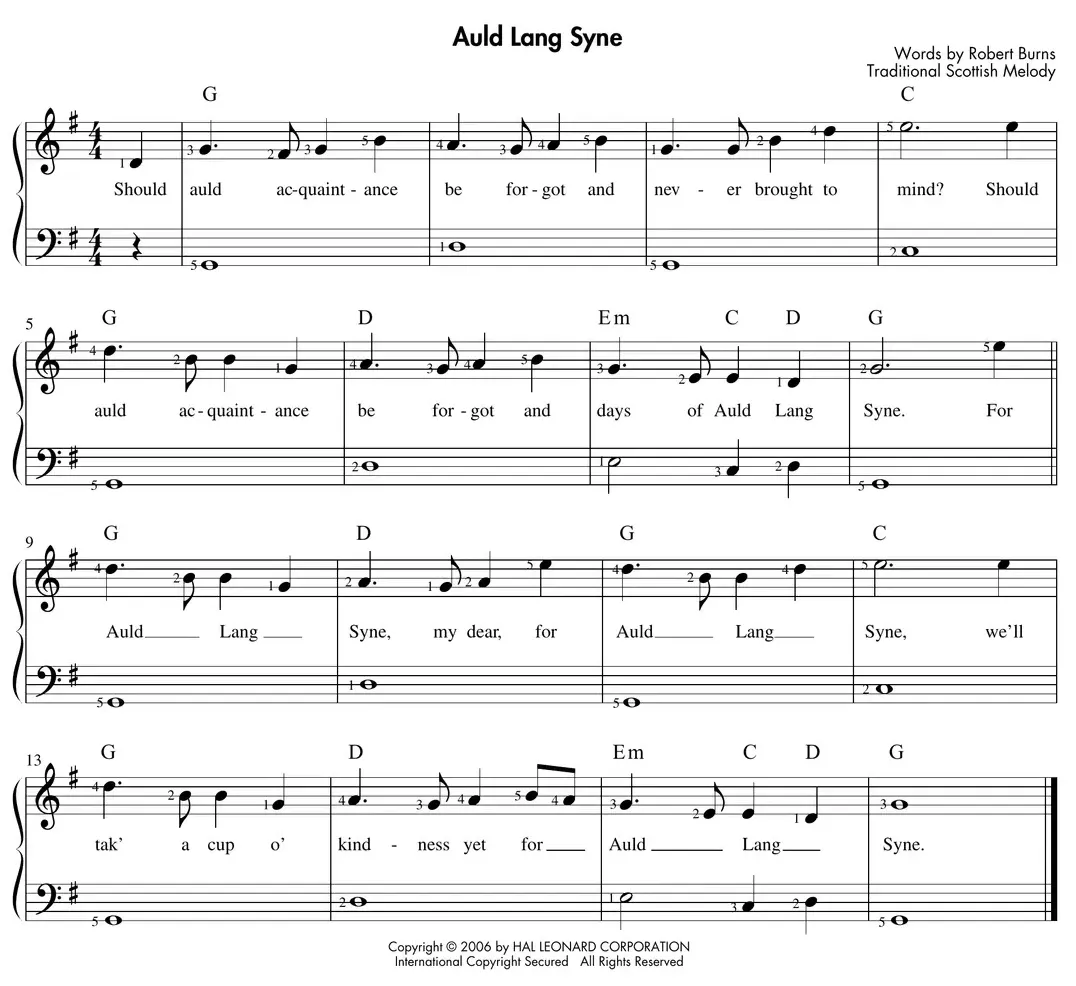
Now you can pretend that it’s New Year’s Eve! Here’s the famous party song “Auld Lang Syne,” with the right hand playing the melody, and the left hand playing single notes below it. The left hand is playing in an extended G Position, and is a bit more adventurous than our accompaniment part for “Ode to Joy.” Notice the chord symbols above the staff. Our left hand part simply plays the roots of these chords. To make matters even more interesting, the right hand moves around quite a bit. Since it is not confined to one position, it is important that you spend a considerable amount of time practicing the right hand by itself before combining both hands. We’ll get into the details of how to tackle a song like this after you take a look at the tune.
Loading audio…
A great way to practice a challenging song like this is to break it up into small groups. These groups may consist of phrases that coincide with the lyrics. For example, the first phrase ends in measure 4 with the lyric “mind.” Practice this part first, several times in a row. First, make sure you find all the correct notes on the keyboard, and play them with the fingerings given. Pay attention to where fingers have to stretch, cross, or turn, as well as places where the whole hand has to move. As we have seen before, it is a good idea to circle the finger numbers in these spots.
Once you have the first phrase learned, move on to the second. When you are comfortable with the second phrase, try playing the first two phrases together, without stopping. Continue this process until you have the whole right-hand part learned. You may work similarly on the left hand, then use the same process again when you put the hands together. Practice this way with all songs, from now on.
If you’re getting stuck as you practice, have a listen to track 26 for some guidance. Once you’ve done all that hard (and fun) work learning the hands separately, try playing along with the recording, one hand at a time. Next, continue working on the hands together, and when you think you’re ready, try playing along with the recording, this time using both hands.
Have you ever wondered what “Auld Lang Syne” means? It translates as “times gone by.” The song is adapted from a traditional Scottish folk song dating back to the 18th century. The Scottish poet Robert Burns is credited with first publishing it in the mid-1790s. The song recalls the days gone by, and says we will always remember them. Guy Lombardo is credited with turning the song into a New Year’s Eve tradition. He first heard the song in his youth, sung by Scottish immigrants in his hometown of London, Ontario. For nearly fifty years, Guy Lombardo and his orchestra performed “Auld Lang Syne” on radio broadcasts on New Year’s Eve.