Playing, Part 1 · Chapter 6: More Notation and Rhythms
“Straight Eighths” vs. “Swing Eighths”
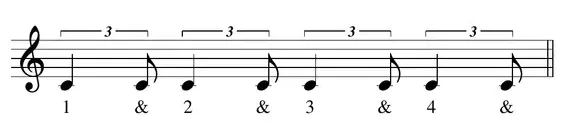
Next, we have an interesting and useful variation of the previous example. Here we're not playing on the middle (second) part of each triplet, just on the first and third parts:
Loading audio…
Listen to track 13 and compare it to track 12. It sounds similar, except that the middle note of each triplet is “missing.” If you were counting it “1 trip-let, 2 trip-let” etc., like track 12, there would be no note falling on the “trip-” syllable. To simplify the counting, we could count it as “1 & 2 & 3 & 4 &” as shown above, but compared to the earlier examples of eighth-note counting in this chapter, each “&” is now later in the beat than before (no longer exactly halfway between the beats). The “&” is now two-thirds of the way through each beat because of the triplet rhythms.
This is where “swing” comes into play. When we want this swing style to be played, instead of going through the trouble of writing out two notes with the triplet sign (the “3” inside the bracket) above each time, as in the previous example, we could just write plain old eighth notes and just play them differently. The first eighth gets held longer (like the quarter note under the triplet sign), and the second eighth is shorter (like the second eighth note under the triplet sign).
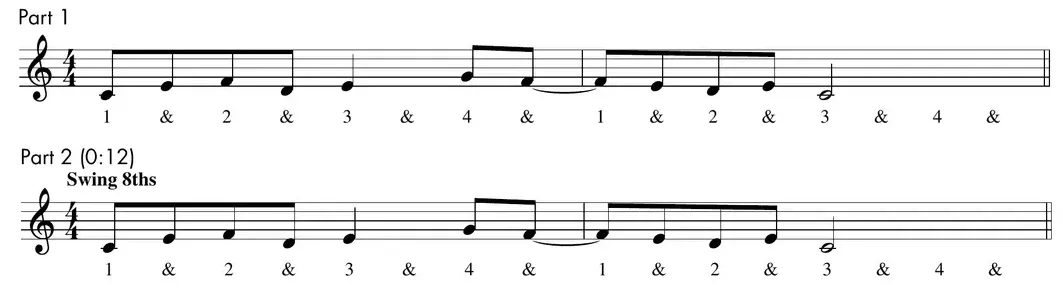
So, how do we know when to play the “even” eighth notes, and when to play the uneven “swing” eighth notes? If the song is to be played swing style, it will be indicated with the word(s) “swing” or “swing eighths” above the time signature, where the tempo would be placed. In the next example, we have the same rhythm twice. The first one will be played “straight,” with even eighth notes. In the second rhythm, we add the “swing eighths” indication above, telling us that this should be played with uneven eighths, like the triplet rhythms we saw earlier.
Loading audio…
This symbol is telling us to play each pair of eighth notes as if it were a quarter note-eighth note triplet,” in other words, to divide each beat in a two-thirds/one-third manner (rather than half-and-half). It's very good practice to begin applying straight and swing-eighths feels to different songs… have fun with this!
Listen to track 14, and notice that Part 1 is played in a straight-eighths style, with each pair of eighth notes dividing the beat exactly in half. In Part 2 the eighth notes are swung, played as if each pair of eighth notes were a quarter note-eighth note triplet, resulting in all the upbeats or “&'s” falling two-thirds of the way through each beat.
If you're at all interested in playing styles such as pop, rock, and jazz, you need to know this! The swing-eighths feel is present in many styles, and you need to know how to get things swingin' when you see this indication in the music.
Usually, if eighth notes are to be played straight, there is no indication of this; you should just assume to play them straight unless you see the “swing eighths” indication. However, occasionally, if you're playing out of a jazz book where most of the music is in swing style, the indication “straight eighths” might be used for a straight tune, to help distinguish it from all the other swinging music.
Also, regardless of how we treat the eighth notes (straight or swing), remember that the downbeats (i.e., beats 1, 2, 3, and 4, in 4/4 time) do not move. We are simply moving the upbeats (or “&s”) in between these downbeats.
In addition to the “Swing eighths” indication at the top, sometimes “Shuffle” is used, or we can use this symbol:
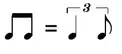
This symbol is telling us to play each pair of eighth notes as if it were a quarter note-eighth note triplet,” in other words, to divide each beat in a two-thirds/one-third manner (rather than
half-and-half). It’s very good practice to begin applying straight- and swing-eighths feels to different songs… have fun with this!