Playing, Part 2 · Chapter 12: More Chords and Inversions
Inverting Major Triads
Let’s start with our good friend the C major triad, and see what happens when we invert it. The notes of the C major chord are C, E, and G, so no matter what order or position we place these three notes in, as long as we have these three, it will always be a C major triad.

We’ll define the different inversions of the C major triad as follows:
- the first triad is in root position (with the root on the bottom)
- the second triad is in first inversion (with the third on the bottom)
- the third triad is in second inversion (with the fifth on the bottom)
- the last triad is in root position, an octave higher than the first.
Back in Chapter 10 we showed the (root position) major triads in all keys. Now it’s time to introduce the inversions of all these, starting with the first inversions:
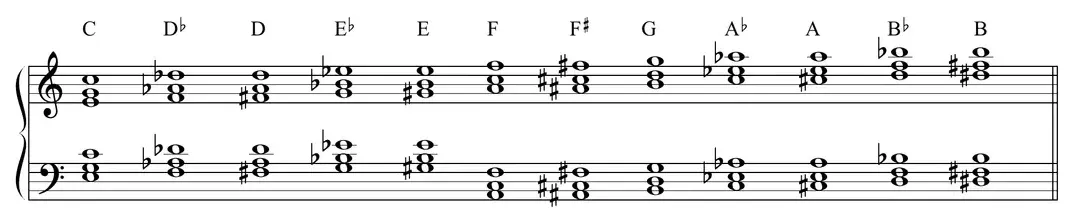
Play through each of these first-inversion triads on the piano, starting with the C triad, hands separately. As there is now a larger interval on top, use a 1-2-5 fingering for each right-hand chord, but still use fingers 5, 3, and 1 for the left hand. Notice the different combinations of black and white keys as you play through all the first inversions.
And now… for the second inversions of the major triads:
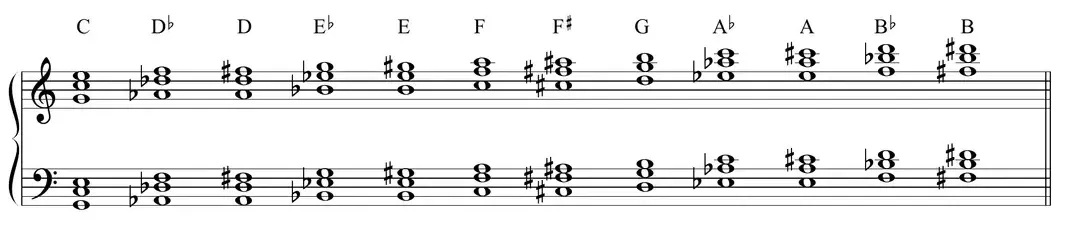
Play through each of these second inversions, again starting with the C triad. The larger interval is now on the bottom, so either a 1-3-5 or 1-2-4 fingering will work fine in the right hand. Use a 5-2-1 fingering for the left hand. Again be aware of the different black and white key combinations as you play.