Playing, Part 1 · Chapter 3: Notation and Rhythms
4/4 Time Signature
Much of the music that you will play will have four beats in each measure. This means that, when we count the beats, after we get to 4 we will go back to 1: “1, 2, 3, 4, 1, 2, 3, 4,” etc. By now you're probably thinking that we need a way to let whoever's reading the music know how many beats there are in each measure. Well, you'd be right. This is called a time signature and is placed right after the clef sign, as follows:
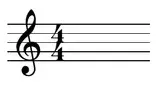
The top number of the time signature (4 in this case) indicates how many beats there are in each measure. These beats are where you would normally tap your foot! The bottom number of the time signature (again 4 in this case) indicates what rhythmic value is assigned to the beat.
We're about to be introduced to different rhythmic values (i.e., note lengths) such as quarter notes, half notes, and whole notes. The 4 at the bottom of the time signature means that each beat in the measure will be a quarter note. The 4/4 time signature, therefore means that there are four quarter-note beats per measure. More about quarter notes in a minute…
The 4/4 time signature is also referred to as “common time,” probably because it is overwhelmingly the most common time signature in music. “Common time” also has its own symbol:
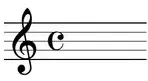
So any time you see this “C” symbol used as a time signature, that's equivalent to 4/4 time. You may see either one—they both mean the same thing.